Guide
6 Best Dumbbell Exercises for Women
Six moves for a full-body strength routine with dumbbells at home, each with a video demo, plus a 25-minute workout to put them together.
Updated · 7 min read
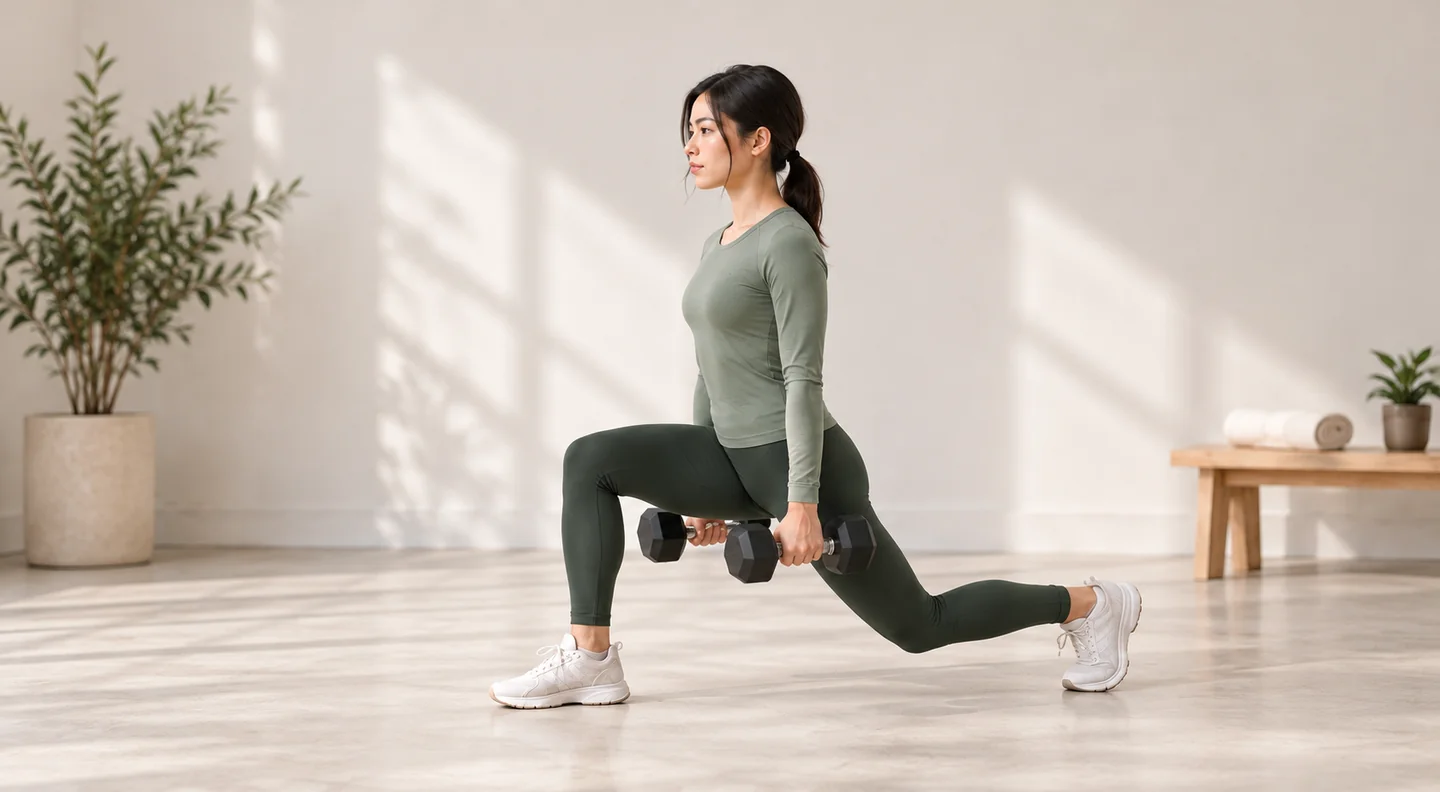
Dumbbells are the most familiar strength tool there is, and for good reason: they are easy to hold, easy to adjust and you can train your whole body with a single pair. These are the six exercises we would build any woman’s dumbbell routine around.
Every move comes with a short video demo, so you can see exactly how it should look before you try it.
How we chose these exercises
- One for each basic movement. A squat, a hinge and a lunge for your legs and glutes; a press and a row for your shoulders and back; a carry for your grip and core.
- They are simple to learn. Each one is safe to pick up from a clear demo and a few cues.
- They work at home. You need a pair of dumbbells and a little floor space.
1. Goblet squat
Works: Legs, glutes and core
The easiest way to learn a good squat. Holding one dumbbell at your chest balances you, so you can sit deeper and stay upright.
How to do it
- Stand with your feet a little wider than your hips, toes turned out slightly.
- Hold one dumbbell upright against your chest, cupping the top end in both hands.
- Sit down between your heels, keeping your chest tall and your heels on the floor.
- Go as low as you comfortably can, then push through your whole foot to stand up.
Coach’s cue: Push your knees out in line with your toes as you sit.
2. Romanian deadlift
Works: Hamstrings and glutes
One of the best moves for the back of your legs. It also teaches the hip hinge, the safe way to bend down and pick things up.
How to do it
- Stand tall with a dumbbell in each hand, in front of your thighs.
- With soft knees, push your hips back and slide the dumbbells down your legs.
- Stop when you feel a strong stretch in your hamstrings, usually around knee height, with your back still flat.
- Drive your hips forward to stand tall again.
Coach’s cue: Keep the dumbbells close enough to brush your legs.
3. Reverse lunge
Works: Legs and glutes
Stepping back makes a lunge easier to balance and kinder to your knees, and training one leg at a time evens out your sides.
How to do it
- Stand tall with a dumbbell in each hand, arms by your sides.
- Step one foot back and lower until both knees are bent and your back knee hovers above the floor.
- Keep most of your weight in your front foot.
- Push through your front heel to step back up. Do all your reps on one side, then switch.
Coach’s cue: Drop your back knee straight down, like an elevator.
Good to know: If balance is tricky, hold one dumbbell at your chest instead.
4. Shoulder press
Works: Shoulders, arms and core
Pressing overhead builds strong shoulders for everyday lifting, and your core works to keep you steady underneath the weights.
How to do it
- Stand tall with a dumbbell in each hand at shoulder height, palms facing in or forward.
- Squeeze your glutes and brace your stomach.
- Press both dumbbells straight up until your arms are straight.
- Lower them back to your shoulders under control.
Coach’s cue: Ribs down and glutes tight, so you press the weights, not your back.
Good to know: Most women press lighter dumbbells than they squat.
5. Bent-over row
Works: Upper back and arms
Rows strengthen the upper-back muscles that pull your shoulders back, a welcome balance to hours spent leaning over a phone or desk.
How to do it
- Hold a dumbbell in each hand. Push your hips back and lean forward with a flat back.
- Let your arms hang straight below your shoulders.
- Pull both dumbbells toward your ribs, squeezing your shoulder blades together.
- Lower them under control.
Coach’s cue: Keep your neck long and your back flat the whole time.
6. Farmer’s march
Works: Grip, core and shoulders
Carrying weight is everyday strength. Marching in place with a dumbbell in each hand trains your grip and teaches your core to keep you tall.
How to do it
- Hold a heavy dumbbell in each hand at your sides.
- Stand tall with your shoulders back and down.
- March slowly in place, lifting each knee to about hip height.
- Keep going for 20 to 40 seconds, then set the dumbbells down with a flat back.
Coach’s cue: Stay tall, as if a string is pulling you up from the top of your head.
A 25-minute dumbbell workout
Put all six together into one full-body session. Do it two or three times a week, with a rest day in between. Move slowly and stop each set with two or three good reps left in you.
Warm-up 4 minutes
- 30 seconds of arm circles
- 10 slow bodyweight squats
- 10 glute bridges with no weight
- 5 reverse lunges each side, no weight
Block 1: three rounds 9 minutes
- Goblet squat × 10
- Bent-over row × 10
- Farmer’s march, 30 seconds
- Rest 60 to 90 seconds
Block 2: three rounds 9 minutes
- Romanian deadlift × 10
- Shoulder press × 8
- Reverse lunge × 6 each side
- Rest 60 to 90 seconds
Cool-down 3 minutes
- Walk around and breathe slowly
- Gently stretch your hips, hamstrings and chest
When every rep feels steady for two sessions in a row, add two reps to each exercise or move up to heavier dumbbells.
What weight dumbbells should a woman use?
Most women starting out do well with a pair of 2 to 4 kg (5 to 8 lb) dumbbells for presses, and a heavier pair of 5 to 8 kg (10 to 17 lb) for squats, deadlifts, lunges, rows and carries. Adjustable dumbbells cover both in one set.
Whatever you choose, pick a weight you can lift for every rep with good form, finishing each set with two or three reps to spare. The weight is right when the last reps take effort but your form stays the same.
Form and safety
- Warm up first, and control the lowering part of every rep. Slow and steady beats heavy and fast.
- Clear your space and train on a non-slip floor. Set dumbbells down gently rather than dropping them.
- Stop if something hurts. Muscles working hard is normal; sharp or joint pain, dizziness or feeling faint is not.
- Be realistic about results. Strength training makes you stronger. How your body changes depends on many things, and no exercise burns fat from one particular spot.
- Pregnant, postpartum or managing an injury or health condition? Check with your doctor or a qualified professional first. Several of these moves need adapting, such as exercises lying on your back later in pregnancy.
Questions
Will lifting dumbbells make me bulky?
No. Building large muscles takes years of dedicated training and eating to support it. A few dumbbell sessions a week make you stronger and more capable; they do not change your size overnight.
Is 20 minutes enough?
Yes, if you are consistent. The American College of Sports Medicine’s resistance training guidance suggests training your major muscle groups at least twice a week and building up gradually. A focused full-body session of 20 to 30 minutes covers that.
How many days a week should I train?
Two or three days a week, with a rest day between sessions, is plenty to start. Add a day only when you are recovering well.
Do I need a pair of dumbbells?
A pair is best: five of these six moves use one. The goblet squat needs just one dumbbell, and the reverse lunge works with one held at your chest.
Can I use a kettlebell instead?
Yes. Kettlebells suit many of the same movements, plus a few of their own, like the swing. See our kettlebell exercises guide.